Apr 16, 2026
Boosting Game Portal Ad Revenue: Smart Strategies That Actually Work.
Maximizing ad revenue from a Game Portal isn’t as simple as throwing a few banners onto a screen and hoping for the best. That approach might have worked years ago—but today, players are more aware, more selective, and far less tolerant of intrusive experiences.
Now, success comes from balance. It’s about creating a space where players actually enjoy spending time, while also delivering meaningful value to advertisers. When done right, ads don’t feel like interruptions—they feel like part of the experience.
The digital advertising world has become intensely competitive, and user expectations are constantly rising. Because of this, understanding high-performing ad formats, how the ad supply chain works, and how players behave within your platform is no longer optional—it’s essential. These elements form the foundation of smart monetization.
If you’re managing a game portal, knowing what to do—and what to avoid—can make a huge difference. Poor decisions can drive players away, while thoughtful strategies can increase both engagement and revenue.
In this article, we’ll explore the most effective ad formats and practical strategies that actually work. More importantly, we’ll look at how portal managers can move beyond basic setups and start building smarter, player-friendly monetization systems that boost revenue without hurting the gameplay experience.
Using High-Impact Ad Formats to Monetize Your Game Portal
If you want to seriously grow your game portal’s ad revenue, the first thing to understand is this—not all ad formats are created equal. The format you choose can make or break your monetization strategy.
Let’s take a closer look at one of the most powerful formats available today:
Rewarded Video Ads
Rewarded video ads have quickly become a favorite in the gaming world—and for good reason. Compared to traditional formats like interstitial ads, they can be up to twice as effective.
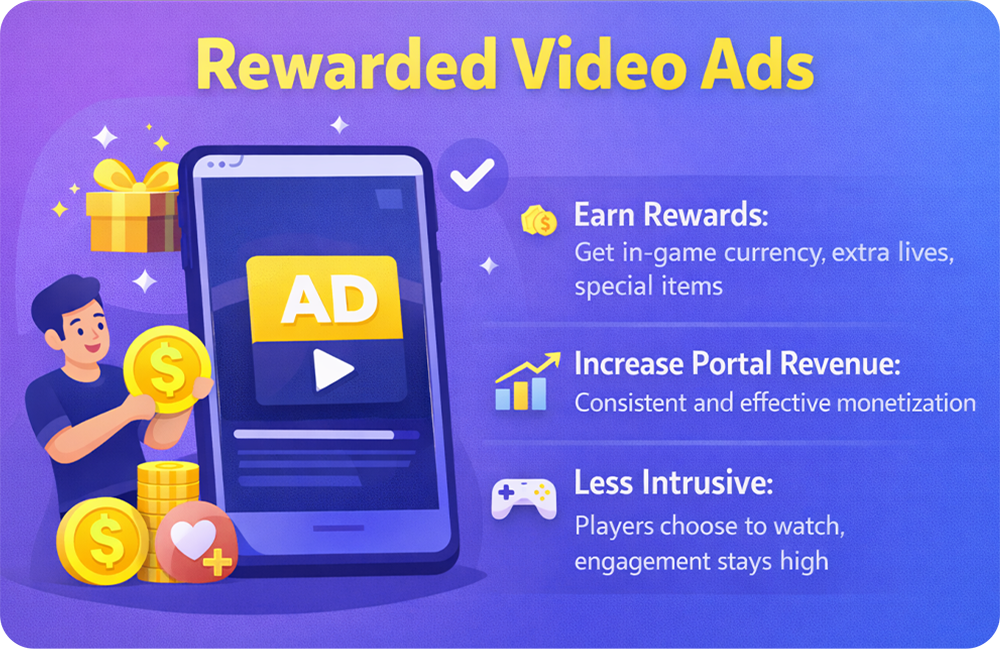
What makes them stand out is how naturally they fit into the player experience. Instead of forcing ads on users, rewarded videos offer something in return—like in-game currency, extra lives, or special items. This simple value exchange changes everything.
In fact, studies show that around 72% of players are happy to engage with rewarded ads. That’s a strong signal that when ads feel fair, users don’t mind them—they actually welcome them.
When implemented properly, rewarded ads create a win-win situation:
Players get meaningful rewards that enhance gameplay
Portal owners earn consistent ad revenue
Engagement stays high because users choose to watch
Another key advantage is that rewarded ads are seen as far less intrusive. Research suggests that over half of gamers consider them the least disruptive ad format, which explains why completion rates are typically very high.
To make the most of this format, it’s important to focus on games that naturally support reward systems. The better the reward integration, the more likely players are to engage.
Promoting these games across your portal can significantly boost both engagement and ad performance—turning casual players into active participants in your monetization strategy.
Full-Screen Interstitial Ads
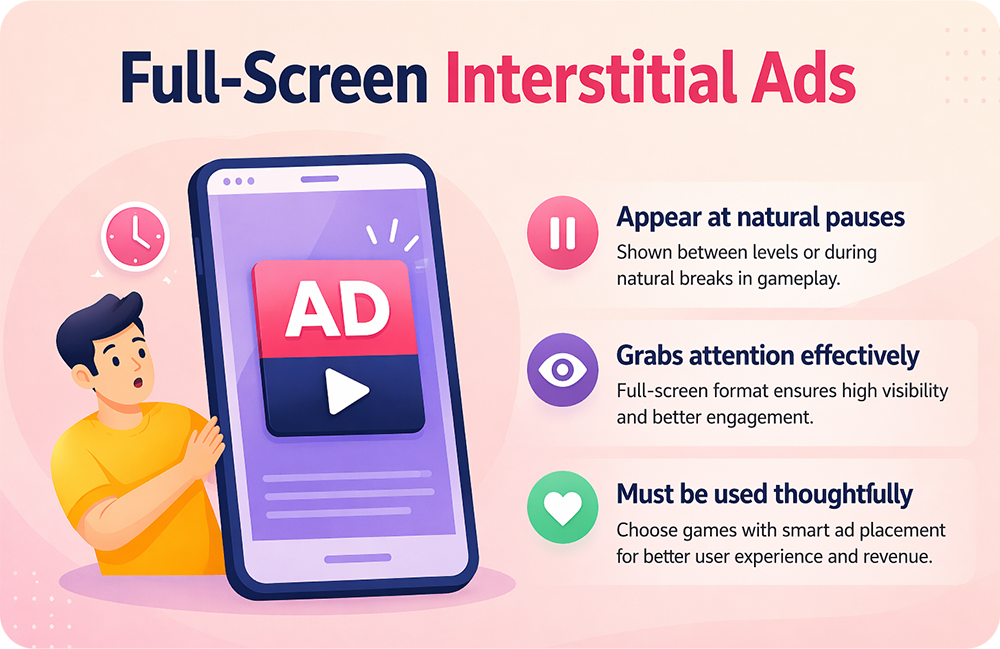
If you’ve ever played a game and seen an ad pop up between levels or during a pause, you’ve already experienced interstitial ads. These full-screen ads appear at natural breaks in gameplay, making them more noticeable than banners—and often more effective.
While game developers usually control where these ads appear, portal managers still have an important role to play. By carefully selecting and promoting games that use interstitials wisely, you can significantly improve both user experience and revenue.
Why do interstitials matter so much? Because when placed correctly, they grab attention without feeling overly intrusive. In fact, studies in other industries have shown that interstitial ads can generate dramatically higher conversion rates compared to traditional banner ads.
But here’s the catch—poor implementation can easily frustrate players and drive them away. That’s why thoughtful curation is key.
Here are a few best practices to follow:
Prioritize Natural Timing: Choose games that show ads at logical breakpoints, like after completing a level—not in the middle of action.
Monitor User Behavior: Keep an eye on engagement and retention metrics to ensure ad frequency isn’t hurting the experience.
Encourage Better Ad Design: Whenever possible, work with developers or partners who support skip options or use more engaging, creative ad content.
When handled correctly, Interstitial Ads can become a strong revenue driver—without compromising the flow of gameplay.
Native & Banner Ads
Not every ad needs to demand attention to be effective. In fact, some of the most reliable revenue comes from ads that quietly blend into the experience—and that’s exactly where native and banner ads shine.
Native ads are designed to feel like a natural part of your platform. On a game portal, they can appear within menus, recommendation sections, or even inside game carousels. Because they match the look and flow of your interface, they don’t interrupt the user journey.
Banner ads, on the other hand, are more traditional. You’ll usually see them placed on homepages, sidebars, or between content sections. While they’re more visible, they can still be effective if used carefully.
Both formats share a common strength—they’re subtle and always present. They may not drive the same high conversions as video-based ads, but they offer consistent, passive income, especially from casual visitors who may not engage deeply with the platform.
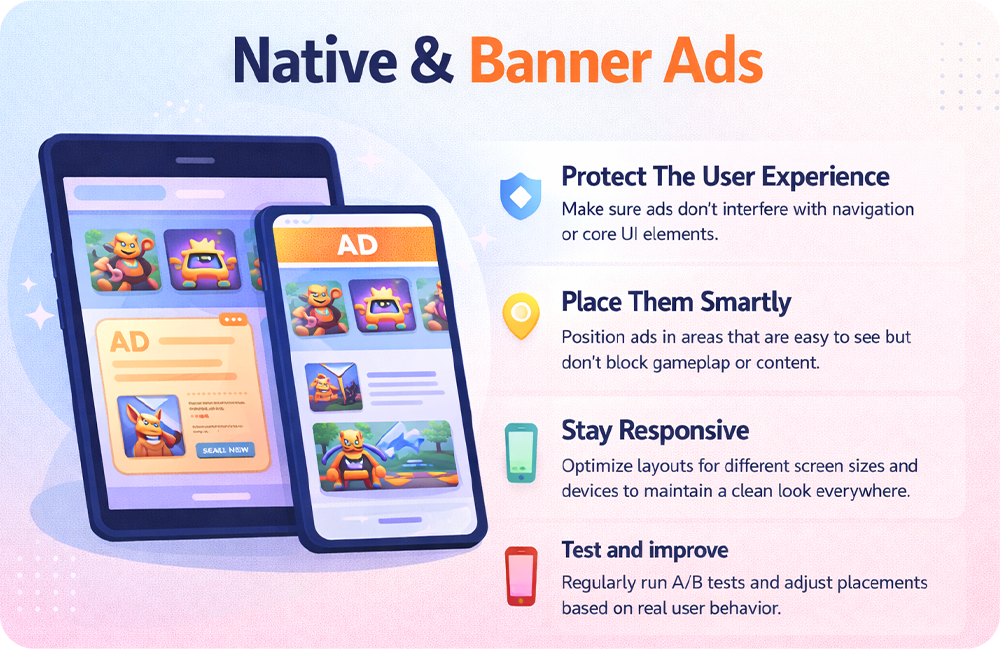
To get the most out of native and banner ads, keep these points in mind:
Protect The User Experience: Make sure ads don’t interfere with navigation or core UI elements.
Place Them Smartly: Position ads in areas that are easy to see but don’t block gameplay or content.
Stay Responsive: Optimize layouts for different screen sizes and devices to maintain a clean look everywhere.
Test and improve: Regularly run A/B tests and adjust placements based on real user behavior.
When used thoughtfully, native and banner ads act as a steady revenue backbone—quietly contributing to your earnings without disrupting the player experience.
Playable Ads
Playable ads have become one of the most engaging ad formats in recent years—and it’s easy to see why. Instead of just watching an ad, users get to actually try a mini version of a game before deciding whether to download it.
This hands-on experience makes a huge difference. It gives players a real feel for the gameplay, which builds interest and trust at the same time. As a result, playable ads often deliver significantly higher conversion rates compared to traditional formats.
For portal managers, the opportunity lies in smart integration. While you may not be creating these ads yourself, you can still benefit by featuring games that use high-quality playable ads or by partnering with ad networks to place them within your platform.
In fact, some reports suggest that playable ads can achieve conversion rates many times higher than standard banner ads—making them especially valuable for performance-driven campaigns.
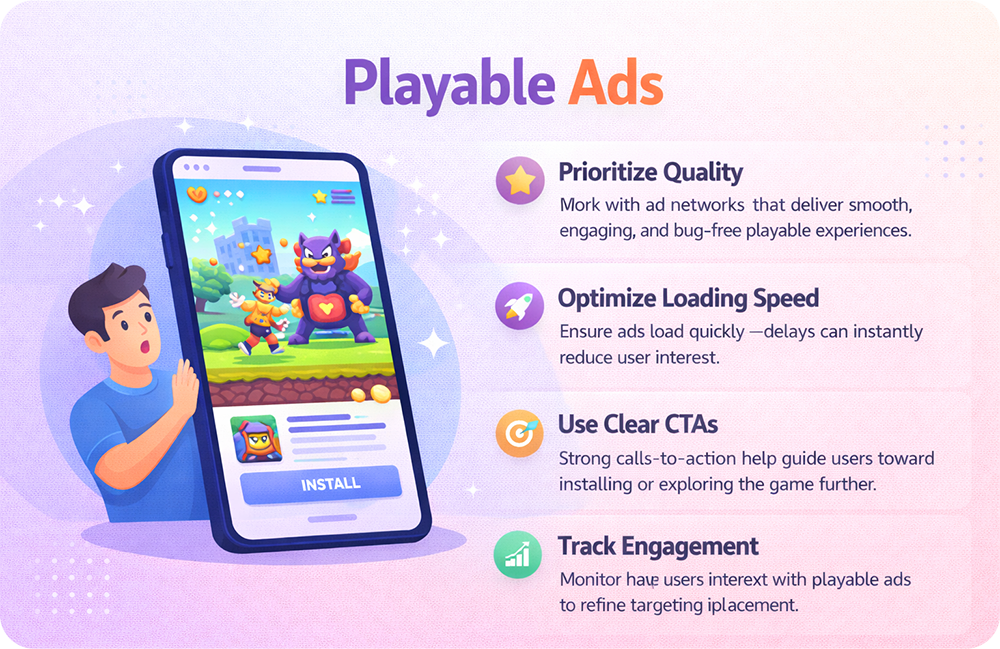
To make the most of playable ads, focus on the following:
Prioritize Quality: Work with ad networks that deliver smooth, engaging, and bug-free playable experiences.
Optimize Loading Speed: Ensure ads load quickly—delays can instantly reduce user interest.
Use Clear CTAs: Strong calls-to-action help guide users toward installing or exploring the game further.
Track Engagement: Monitor how users interact with playable ads to refine targeting and placement.
Playable ads are particularly effective for user acquisition and work exceptionally well in promotional spots across your portal. When used correctly, they don’t just advertise. They let users experience, which is far more powerful.
Engineering Your Ad Supply Chain
If ad formats are the visible part of monetization, then your ad supply chain is what works behind the scenes to truly maximize revenue. A well-structured system ensures that every ad impression is used efficiently—and sold at the best possible value.
In today’s complex advertising ecosystem, relying on basic setups is no longer enough. To stay competitive, game portals need smarter, data-driven infrastructure that can adapt in real time.
Dynamic Price Floors & Mediation
One of the most effective ways to improve monetization is through dynamic price floors. Instead of setting a fixed minimum price for ad impressions, dynamic pricing adjusts those floors automatically based on real-time data.
This means your platform can respond instantly to changes in demand, user behavior, and market conditions—helping you extract more value from every impression. In fact, studies have shown that dynamic floor pricing can significantly increase revenue compared to static pricing models.
But to make it work effectively, you need to consider multiple factors, such as:
User behavior and engagement patterns
Time-based demand fluctuations (e.g., peak vs off-peak hours)
Geographic differences in user value
Historical performance data
Current market demand
Ad unit performance across different devices
Alongside dynamic pricing, Mediation Platforms play a critical role. These platforms connect multiple ad networks and ensure that each ad request is offered to the highest bidder.
Modern mediation has evolved far beyond traditional waterfall setups. With the introduction of in-app bidding, multiple ad networks can now compete in real time for each impression. This increases competition, improves fill rates, and ultimately drives higher revenue.
When dynamic pricing and advanced mediation work together, they create a powerful system. one that maximizes every opportunity without compromising performance or user experience.
Real-Time Bidding (RTB)
Imagine you’re in the middle of a game, and it’s time for an ad break. What actually happens in that split second is more sophisticated than most people realize.
Real-Time Bidding (RTB) works like a lightning-fast digital auction happening behind the scenes. So fast that it’s completed before the ad even appears on your screen.
Here’s how it works in simple terms: every time there’s an opportunity to show an ad, multiple advertisers instantly compete for that spot. Each one places a bid based on how valuable that impression is to them. Taking into account factors like your behavior, the type of game you’re playing, your location, and even the time of day.
The highest bidder wins, and their ad gets displayed.
You can think of RTB as a micro-auction that runs every single time an ad is served.
This system brings several powerful advantages:
Higher Revenue Potential: When advertisers compete in real time, they often bid higher—driving up the value of your ad inventory.
Better Fill Rates: With multiple advertisers in the mix, the chances of leaving an ad slot empty are much lower.
Increased eCPM: Competition naturally pushes up the effective cost per thousand impressions, meaning each ad view becomes more valuable.
Smarter Targeting: Ads are shown to users who are more likely to be interested, improving performance for advertisers.
Improved User Experience: Because ads are more relevant, they feel less intrusive and more useful to players.
In short, RTB transforms ad serving into a smart, competitive ecosystem. One that benefits both portal owners and players when implemented correctly.
eCPM and Ad LTV Explained
Running a profitable game portal isn’t just about showing ads. It’s about understanding what those ads are actually earning you. Just like any successful business, you need to track the right metrics to know what’s working and what needs improvement.
Let’s break down two of the most important ones in a simple, practical way:
eCPM (Effective Cost Per Thousand Views)
Think of eCPM as the value of your ad inventory. It tells you how much you earn for every 1,000 ad impressions. For example, if your eCPM is $5, it means you earn $5 every time your ads are viewed 1,000 times.
This metric helps you answer a key question:
“How much is each ad impression really worth?”
By tracking eCPM, you can compare performance across different ad formats, placements, and user segments—and quickly identify which ones are generating the most revenue.
Ad LTV (Lifetime Value from Ads)
While eCPM focuses on individual impressions, Ad LTV looks at the bigger picture.
Ad LTV measures how much revenue a single player generates through ads over their entire time on your platform. For example, you might estimate how much a user earns you over 30, 60, or 90 days before they stop playing.
This metric answers another critical question:
“How valuable is each user over time?”
When you understand Ad LTV, you can make smarter decisions about user acquisition, retention strategies, and ad frequency—ensuring that you maximize long-term revenue without hurting the player experience.
Why These Metrics Matter Together
eCPM tells you how well your ads perform right now.
Ad LTV tells you how much each player is worth in the long run.
When you combine both, you get a much clearer picture of your portal’s true earning potential—and that’s where real optimization begins.
Using eCPM & Ad LTV to Maximize Game Portal Revenue
Tracking metrics like eCPM and Ad LTV is important—but the real value comes from how you use that data to make better decisions.
Start by Understanding What Works
Not all ads perform the same, and your data will quickly reveal that. Some formats naturally bring in more revenue than others.
For example, you might notice that rewarded video ads consistently outperform banner ads. Insights like this help you focus on what’s actually driving earnings instead of relying on guesswork.
At the same time, keep a close eye on player behavior.
Are users dropping off because there are too many ads?
Or are certain placements encouraging them to stay longer?
These patterns matter more than raw numbers.
Finding the Right Balance
There’s no single “perfect” setup, it comes from testing and refining over time.
Try experimenting with questions like:
How often can you show ads without frustrating players?
Where should ads be placed for maximum visibility without disruption?
Which ad formats do your players respond to the most?
Small adjustments here can lead to big improvements in both engagement and revenue.
Let Data Guide Your Decisions
Once you start collecting enough data, it becomes a powerful tool. It can help you uncover insights such as:
The best times to show ads for higher engagement
Which ad networks are delivering the highest returns
How to balance monetization with a smooth gameplay experience
Instead of relying on assumptions, you’re making decisions backed by real user behavior.
Don’t Forget the Player Experience
At the end of the day, your players are the foundation of your revenue.
If they enjoy the experience, they’ll stay longer, engage more, and naturally view more ads. But if ads become annoying or disruptive, even the best monetization strategy will fail.
That’s why the goal isn’t just to increase ad revenue—it’s to do it in a way that keeps players happy.
Because when you get that balance right, growth becomes sustainable.
Player-Centric Triggers for Smarter Game Portal Monetization
Ever wondered why some games are surprisingly good at getting you to watch ads without feeling annoyed? That’s not luck. It’s smart use of psychology.
By understanding player behavior and using the right triggers, you can significantly improve ad engagement while keeping the experience enjoyable.
Perfect Timing Matters
Think about the moment you fail a tough level and see a “Watch Ad for Extra Life” option. That’s not random—it’s perfectly timed.
The best-performing ads appear when players actually need something. It’s similar to placing cold drinks at the checkout counter on a hot day—relevant, timely, and hard to ignore.
Even small details like button text can make a huge difference. For example, changing a button from “Watch Ad” to something more action-driven like “Revive,” along with a better color choice, can dramatically improve clicks and engagement.
The Power of Instant Rewards
People love instant gratification and games use this to their advantage.
Instead of offering vague benefits, successful games provide immediate, tangible rewards, such as:
Extra lives right when players need them
Quick in-game currency or gems
Instant-use power-ups
Easy-to-claim bonuses
The quicker the reward, the higher the engagement.
Making It Social and Competitive
Games also tap into our natural desire to compete and be recognized.
They do this by:
Showing leaderboards of top players
Offering badges or achievements for active users
Creating community challenges
Rewarding players for sharing progress
When players feel seen or competitive, they’re more likely to stay engaged—and interact with ads along the way.
The “Don’t Miss Out” Effect
Scarcity and urgency are powerful motivators.
That’s why many games use:
Limited-time offers (“Today Only!” deals)
Daily reward streaks tied to ad views
Time-limited events
Exclusive rewards for consistent activity
These elements create a sense of urgency that encourages repeated engagement.
Keeping Things Fresh and Interesting
Just like a good TV series, games keep players hooked with curiosity and surprise.
This can include:
Mystery rewards
Random in-game events
Frequent content updates
Rotating exclusive offers
When players don’t know what’s coming next, they’re more likely to stay—and engage.
The “I’ve Already Started” Effect
Once players invest time in a game, they’re more likely to continue. Smart games build on this by:
Offering early rewards to hook players
Creating satisfying progression systems
Giving milestone-based bonuses
Providing exclusive perks for loyal users
This builds commitment—and long-term value.
A Simple Truth
The best games don’t force ads on players.
They make ads feel like a choice and sometimes even a benefit.
Closing Insights
In today’s fast-moving gaming industry, monetization isn’t about showing more ads, it’s about showing them better. From understanding player psychology to leveraging advanced systems like real-time bidding and dynamic pricing, successful portal managers treat advertising as part of the overall experience, not just a background process.
As we’ve explored, strategies like rewarded ads, smart interstitial placement, and data-driven optimization prove that effective monetization is both an art and a science.
The key takeaway is simple:
Ads shouldn’t interrupt gameplay, they should enhance it.
When you get that balance right, ads stop feeling like distractions and start becoming part of what keeps players coming back.